

We hear plenty about the importance of preserving muscle during weight loss, but the research raises some interesting questions. Do people actually move more on these medications? Are there exercise guidelines specifically for GLP-1 users? What does a drop in lean mass tell us? And could exercise help with maintaining weight loss after treatment stops?
Do people move more on GLP-1?
It’s easy to assume that losing weight might naturally lead to moving more. But does the research bear that out?
A recent systematic review looked at seven studies from six independent trials, involving 924 adults with overweight or obesity. It focused on objectively measured activity, using devices and exercise monitoring rather than relying on what participants reported.
The main findings:
No clear increase in activity. Most studies found no statistically significant difference between medication and control groups. The main pooled analysis of three randomised trials found no significant effect either.
Some signs of less everyday movement. Five studies reported numerically lower activity in the medication groups, although only one found a statistically significant reduction: around 1,144 fewer steps per day compared with controls.
Planned exercise participation was similar. Studies measuring adherence and time spent doing prescribed exercise found no significant differences between groups.
When additional evidence, including a non-randomised study, was included in the pooled analysis, a small reduction in activity emerged.
One important limitation: all included studies used liraglutide or exenatide. So it can’t be assumed the same findings apply to semaglutide or tirzepatide.
GLP-1s and lean mass loss
A 2026 systematic review examined how lean mass changes during weight loss with semaglutide, tirzepatide, liraglutide and lifestyle interventions.
The authors reported the following proportions of total weight loss coming from lean mass:
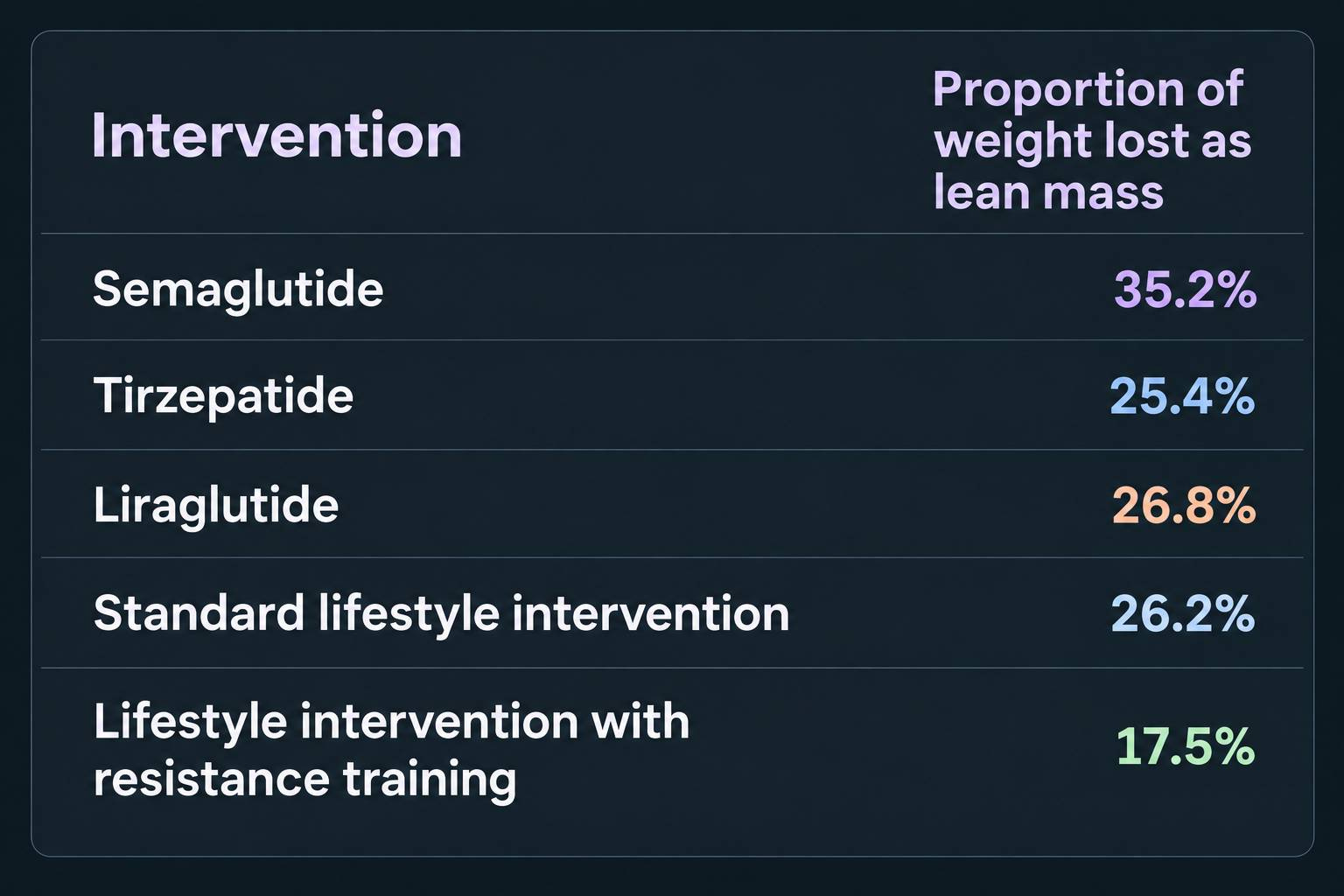
Across medication groups combined, the proportion was not significantly different from standard lifestyle interventions. Lifestyle programs incorporating resistance training had the lowest reported proportion.
Although the estimate was higher for semaglutide than tirzepatide, these were comparisons across different trials, not a direct head to head study.
Lean mass loss: what is actually being measured?
Those percentages can look concerning, especially when “lean mass loss” becomes “muscle loss” in headlines. But these terms aren’t interchangeable.
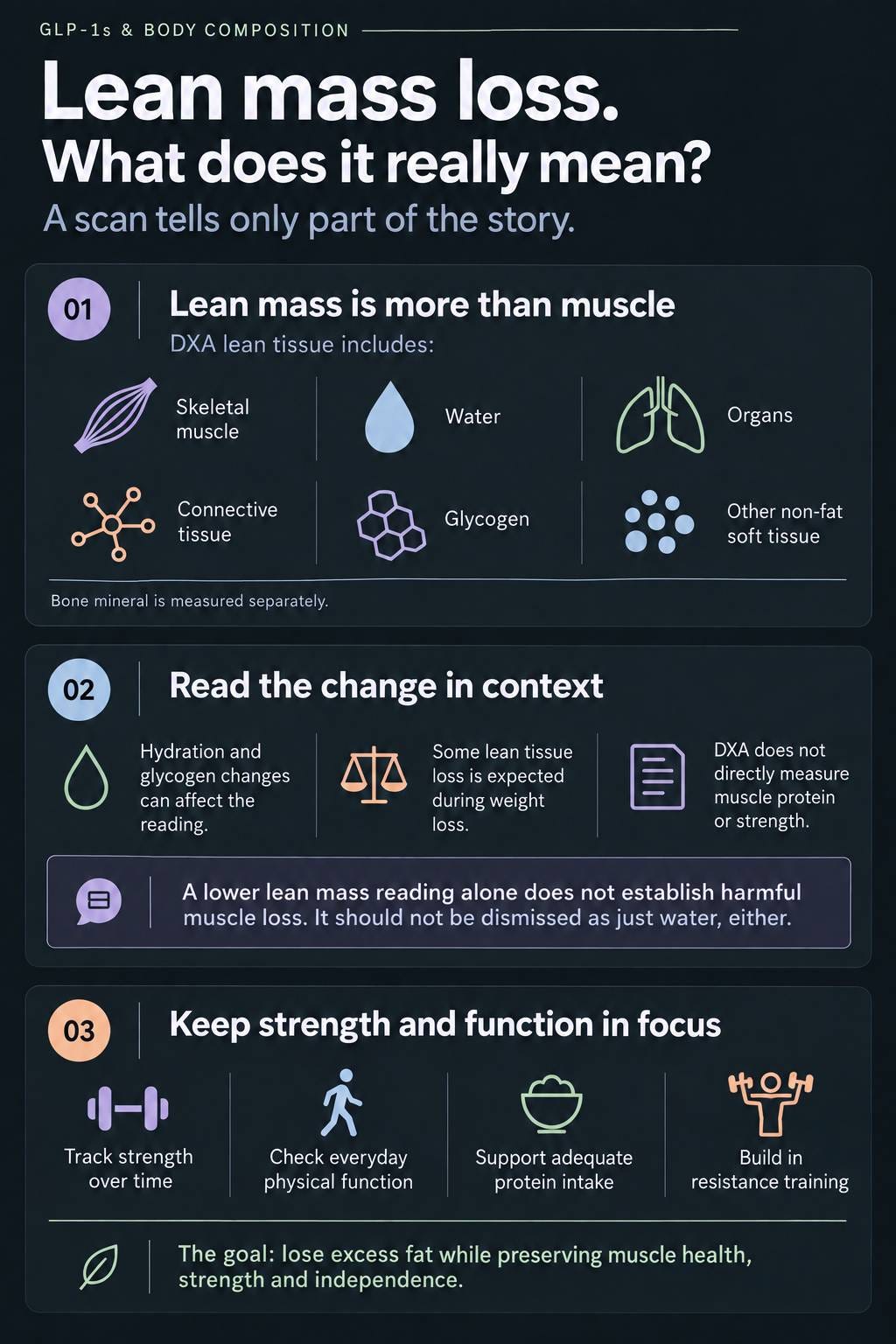
Lean mass includes more than muscle. On a DXA scan, it includes skeletal muscle, organs, connective tissue, water and glycogen. Bone mineral is measured separately. The scan estimates these compartments; it doesn’t directly measure muscle or tell us how strong someone is.
This is important during weight loss because changes in hydration and glycogen stores can contribute to a reduction in measured lean mass. Some lean tissue loss is also expected as body weight decreases, including with lifestyle interventions. A fall in lean mass on a scan doesn’t automatically establish harmful muscle loss. Equally, we shouldn’t assume it is all water or dismiss the possibility of meaningful muscle loss.
A fuller picture would include muscle mass, quality, strength and function.
In the SURPASS-3 MRI trial, thigh muscle volume decreased with tirzepatide broadly in line with what would be expected for the amount of weight lost, while fat infiltration within the muscle improved.
Similarly, the SEMALEAN study of semaglutide 2.4mg, found that lean mass declined initially before stabilising, while handgrip strength improved over 12 months.
This is still an emerging area, and future research should help clarify what changes in lean mass actually mean for muscle health and function.
Muscle and bone health: who needs closer attention?
Older adults and people with existing low strength or frailty may be more vulnerable to muscle loss during weight reduction. Recent reviews highlight these concerns, but evidence that GLP-1 treatment causes clinical sarcopenia remains limited.
Bone health is another area to watch. A secondary analysis of a randomised trial found that liraglutide alone led to greater hip and spine bone-density loss than exercise alone. Combining both produced the greatest weight loss, without significantly greater bone-density loss than placebo.
Exercise could play a key role in weight maintenance
A study examining long-term weight maintenance after stopping liraglutide found that outcomes generally favoured combining medication with supervised exercise over liraglutide alone. During the year after medication and supervised support ended, those previously receiving both regained less weight on average (7.1 kg) than those receiving liraglutide alone (9.6 kg).
The combination group also had more favourable changes in body fat percentage and waist circumference over the full study period. These findings suggest potential benefits for longer-term body composition maintenance.
What exercise is currently recommended?
Major professional bodies increasingly emphasise resistance training during GLP-1 treatment, with some of the clearest frequency targets coming from the joint advisory by the American College of Lifestyle Medicine, American Society for Nutrition, Obesity Medicine Association and The Obesity Society.
Their recommendations are to work towards:
Strength training at least three times per week.
At least 150 minutes of moderate-intensity aerobic exercise per week
An individualised program matched to the person’s fitness and physical capacity.
These recommendations offer a practical target to build towards, while the optimal exercise dose specifically for people taking GLP-1s remains uncertain.
ESSA’s position on GLP-1s and exercise
Exercise & Sports Science Australia (ESSA) has published a recent position statement calling for Accredited Exercise Physiologists to be integrated into the care of people using GLP-1 medications for weight management.
The message is clear: preserving muscle, strength and physical function should be core goals of treatment. ESSA supports these medications within multidisciplinary care, with individually prescribed exercise alongside medical oversight and nutrition support.
The statement outlines how exercise physiologists can help: assessing physical capacity, tailoring programs around existing conditions and treatment side effects, and supporting sustained activity and long-term weight maintenance. It also calls for clearer referral pathways and funding that makes this care more accessible.
Getting people to actually do resistance training
Dr Ken Fujioka, a leader in obesity medicine at Scripps Clinic, recently spoke on the Weight Loss And podcast about how difficult it is to get patients to exercise. He described getting close to telling patients he won’t prescribe weight loss medication unless they start resistance training, framing it as a way to motivate them rather than a formal prescribing policy.
That matches what I see. I lead a GLP-1 program where we track member habits, and strength training is consistently the area that needs the most support. People will eat more protein but getting resistance training into their week is often much harder.
There’s still plenty to learn about GLP-1s and exercise. Alongside the questions about muscle loss and optimal exercise prescription, there’s a more everyday question: what would make resistance training feel achievable for the person in front of us? I think that deserves just as much attention.
References
Exercise & Sports Science Australia. (2026). Policy position: Role of exercise physiology in the safe use of GLP-1 medications.
Kim, H., Chae, J. H., & Moon, H. Y. (2026). The impact of glucagon-like peptide-1 receptor agonists on objective physical activity in adults: A systematic review and exploratory meta-analysis. International Journal of Obesity. https://doi.org/10.1038/s41366-026-02141-z
Eisa, N., & Barood, O. (2026). Lean mass changes with incretin therapy versus lifestyle intervention: A systematic review and meta-analysis of randomised controlled trials. Diabetes, Obesity and Metabolism, 28(6), 4818–4827. https://doi.org/10.1111/dom.70666
Neeland, I. J., Linge, J., & Birkenfeld, A. L. (2024). Changes in lean body mass with glucagon-like peptide-1-based therapies and mitigation strategies. Diabetes, Obesity and Metabolism, 26(S4), 16–27. https://doi.org/10.1111/dom.15728
Sattar, N., Neeland, I. J., Dahlqvist Leinhard, O., et al. (2025). Tirzepatide and muscle composition changes in people with type 2 diabetes (SURPASS-3 MRI): A post-hoc analysis of a randomised, open-label, parallel-group, phase 3 trial. The Lancet Diabetes & Endocrinology, 13(6), 482–493. https://doi.org/10.1016/S2213-8587(25)00027-0
Alissou, M., Demangeat, T., Folope, V., et al. (2026). Impact of semaglutide on fat mass, lean mass and muscle function in patients with obesity: The SEMALEAN study. Diabetes, Obesity and Metabolism, 28(1), 112–121. https://doi.org/10.1111/dom.70141
Memel, Z., Gold, S. L., Pearlman, M., Muratore, A., & Martindale, R. (2025). Impact of GLP-1 receptor agonist therapy in patients at high risk for sarcopenia. Current Nutrition Reports, 14, 63. https://doi.org/10.1007/s13668-025-00649-w
Batsis, J. A., Donini, L. M., & Prado, C. M. (2026). Unintended risks of sarcopenic obesity during weight-loss interventions in older people. Nature Medicine, 32(3), 776–777. https://doi.org/10.1038/s41591-026-04210-2
Jensen, S. B. K., Sørensen, V., Sandsdal, R. M., et al. (2024). Bone health after exercise alone, GLP-1 receptor agonist treatment, or combination treatment: A secondary analysis of a randomised clinical trial. JAMA Network Open, 7(6), e2416775. https://doi.org/10.1001/jamanetworkopen.2024.16775
Jensen, S. B. K., Blond, M. B., Sandsdal, R. M., et al. (2024). Healthy weight loss maintenance with exercise, GLP-1 receptor agonist, or both combined followed by one year without treatment: A post-treatment analysis of a randomised placebo-controlled trial. eClinicalMedicine, 69, 102475. https://doi.org/10.1016/j.eclinm.2024.102475
Wyatt, H., & Hill, J. O. (2026, May 27). What comes after GLP-1 success with Ken Fujioka. Weight Loss And. https://www.weightlossand.com/what-comes-after-glp-1-success-with-ken-fujioka/
Mozaffarian, D., Agarwal, M., Aggarwal, M., et al. (2025). Nutritional priorities to support GLP-1 therapy for obesity: A joint advisory from the American College of Lifestyle Medicine, the American Society for Nutrition, the Obesity Medicine Association, and The Obesity Society. The American Journal of Clinical Nutrition, 122(1), 344–367. https://doi.org/10.1016/j.ajcnut.2025.04.023